


Vladislav
-
Posts
8,135 -
Joined
-
Last visited
-
Days Won
79
Content Type
Profiles
Forums
Gallery
Events
Blogs
BMT Wiki
Collections
Store
Everything posted by Vladislav
-
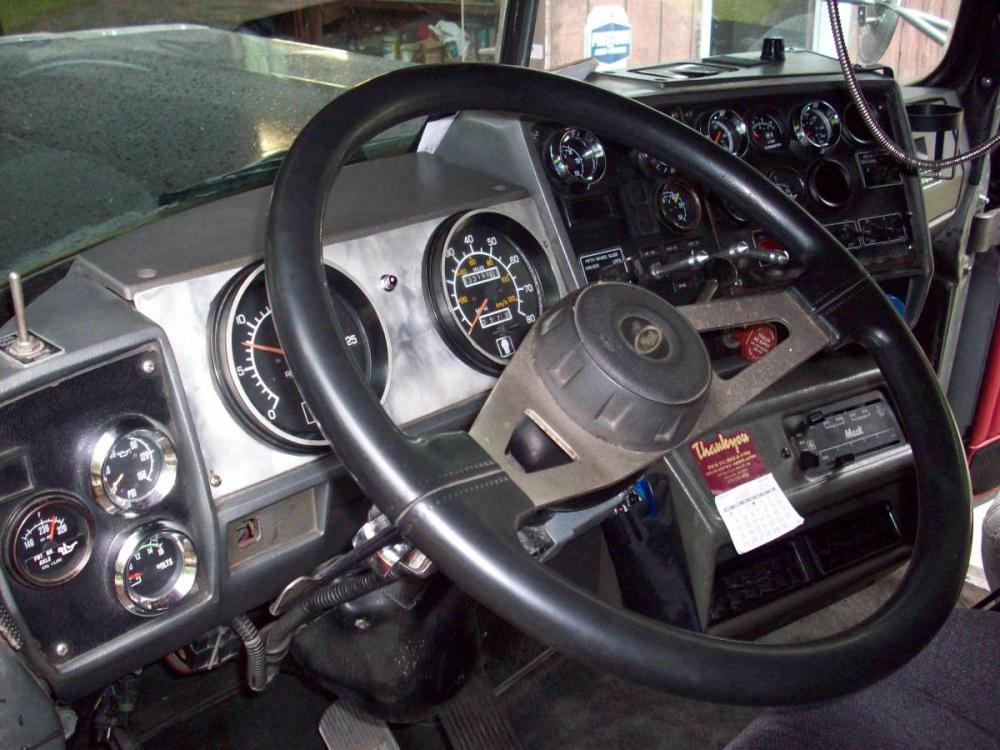
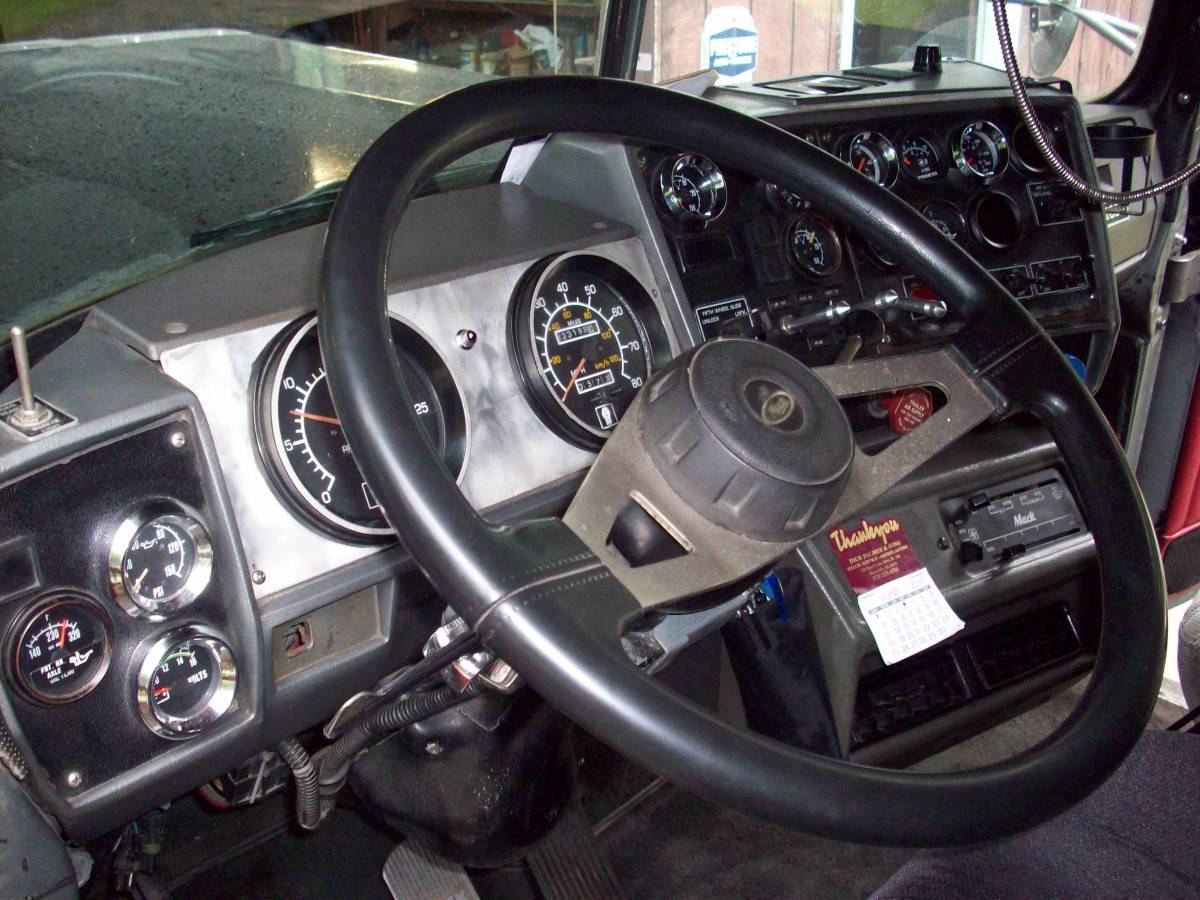
I fitted a wheel off 2002 Mack Vision and if suited 1988 R-model steering column fine. Had that same black rubber wheel you was telling about and got newer style which looks good on my mind. The pic is not my truck but the same look.
-
Great to hear and welcome to BMT! I never met Mike in person (unfortunately) but had a few private conversations with him. Hoped to make a trip to his place some day to check out the collection but the things turned out different. A sad reminder on better to do what you can when you can otherwise a back burner deal may burn away. I wish you good luck on restoring those trucks. Pretty sure Mike would be happy to see them finished if only he could. Vlad
-
Coca Cola LJ Mack colors
Vladislav replied to 1961H67's topic in Antique and Classic Mack Trucks General Discussion
The ones on a H-model seem taller than on a L or a C. The latter two definitely differ being installed into openable frames (L) or straight into a gasket (C and B with L cab). I doubt the width differs (exctepting frames or a gasket) since both day cab or integrated sleeper cab on a L-model have the same cowl to suit the hood. -
Coca Cola LJ Mack colors
Vladislav replied to 1961H67's topic in Antique and Classic Mack Trucks General Discussion
H-model windscreens are not interchengeable with a L-model. They are but with an integral sleeper L cab. -
Cool to see that picture #5025. It shows out the life goes on and also brings hopes the U-model has chances to be finished some day. Glad to learn Vinny was fine.
-
Ohio Vintage Truck Reunion
Vladislav replied to h67st's topic in Antique and Classic Mack Trucks General Discussion
Wow! Thanks, Larry. If you ever see the truck again (and if you will happen keeping this point in your mind) please pay a bit of attention to the sleeper. The one I have on my R (and the one I built) seemed a kind of unique since I never saw a similar bunk on any truck or a picture. The one on the B is not a 100% copy too but very (95%-?) similar. I have no practical need in any info about it having my bunk almost finished. But would be cool to learn its origin and design details. I will try finding the truck owner's contact info either. Thanks. -
I'm really glad to say thanks for the Macungie photo album! Spent a couple of hours yesterday observing the pics of those nice trucks. Sure saved a few on my hard drive. Although it's difficult to choose a favorite in such the case my "truck of the day" was a rusty heavy L-model on a lowboy hooked up to a Pete tractor. Worth to mention the fuel money you spent on the drive to the show gave fun for many others either. Very appreciated!
-
Tom, I got to good practice (as it seems to me) using my digital camera. I just buy new memory card after a current one is full, or preferrably a bit earlier if I'm going to some event or a trip. The "used" one gets off and puts on a shelf with a mark on it. So you can always access all your images in original resolution if ever need. Nice looking r model indeed. Bronze color is fine! Seems like difficult to purchase and also keep owning. But no need to restore since she's self making up. Haven't opened the Macungie album yet. Just going to. Thanks in advance!
-
Ohio Vintage Truck Reunion
Vladislav replied to h67st's topic in Antique and Classic Mack Trucks General Discussion
Thanks for sharing the pictures! I sure heard about that show in the past but now learned more facts from Larry's post. Does anybody know the owner of red and white B73 with L-model cab? The sleeper on the truck looks very close to what my SGT R-model have and I enjoy suffer difficulty identifying the producent. -
But you had great time (at least I hope so). And we can fill our tanks only being in this part of reality, on Earth. Sure no point in spreading cash left to right. But sometimes it worth to pay a bit more than would be pleasant for things you can do today since you never know what you will be able to do tomorrow. Thanks for sharing Tom. I too hope to see more if you find time to upload.
-
You may be sorry in the future after not doing that. Would be a really cool adventure. Worth to bother imagination a bit, maybe looking for a non-profit but fuel paying load to cover some big portion of the distance.
-
There are two ways to set the mesh. 1st is using that asked tool and fitting pinion to the size marked on the gear set. The tool (more correctly to say the main tool of a set) is something you put in place of the differential since the base you measure the distance is the imaginal axle of the differential spin. But you need a physical base and not an imaginable. So you need a kind of cylindrical boss you put into the diff bearing basements imitating the diff and measure (with a measure tool) from it. Than make math and choose the shim thickness. I made such the tools for Mercedes car differentials I rebuild for money but wnen I started using the method I found out the actual mesh I got setting by the marked distance was not perfect (or sometimes quite wrong). So there's the 2nd way setting the mesh by check-printing it (as mentioned above) and correcting actual positions of the gears changing the shim pack thickness. Any book describing process setting of a diff gear mesh no matter truck or a car tells which gear to move which way to obtain correct mesh print. This method is more correct that setting by the marked distance since you see the actual teeth contact area. Which is important not only for no noise but for correct stress distribution between the teeth. Worth to point out the job is time consuming patient process not a common mechanical work. Vlad
-
Damn sad to hear your motor bike crash stories guys. Wish speedy recovery and enjoy other kinds of activities if riding doesn't seem as fun anymore. I noted I ride less in the recent years . Made a few really long holiday trips in the past cruising to Europe for a couple of weeks. The greatest adventure was a travel to Turkey where I happened to go to Istanbul, Ankara and Antalya on Mediterranian coast. Have that done in 2010 and got feeling of a big deal done and moved focuse of interest to trucks. And also big trips with a car since my kid grew up to age suitable to keep my company in such adventures. Hope Macungie will be no less greater event as in the past. Drooling to see fresh pictures from the showgrounds since currently I'm not supposed to be able to put my foot print onto in the foreseen futrure.
-
Coca Cola LJ Mack colors
Vladislav replied to 1961H67's topic in Antique and Classic Mack Trucks General Discussion
A candy! -
Yes, the 1st thing you should do is investigate the matters you have. The truck's foreseen purpose, tyre size, diffs ratio... The time you're going to spend on its fix and amount of $$$ reasonable to invest. Physically it's possible to install any of Mack straight six engine in a R-model with the most kinds of Mack transmissions produced during the same time frame. There are a few mods of attachments but they all seem commonly used and able to be located if you are free enough on time to go visiting a few scrap yards looking for what you need. At the same time cost of labour is sufficient and its amount would be as larger as further you go from the original specifications of the truck. There's one more point to keep in mind though on how good for your jobs those original specs would be. The way I would go in your case is looking for an engine close to what was in the truck from the factory but of higher HP maybe such as 4V EM6-300 or EM7-300 and T2070 or T2080 tranny since these would give you more performance requiring very similar amount of job to install. Or there may be even another way fitting E6-350 Econodyne with T2090 or T2100 tranny if on-highway job is foreseen and rear end ratio is fast enough for. One thing for sure is as more info you accuire as less money and time will be spent. And the dependance curve is not straight
-
Joey, you estimate me higher than the worth I really have as it seems to me . I only have a few hundered square meters of old Mack iron laying around and a shelf of books which are less in number than your collection's score. Thank you for the kind words.
-
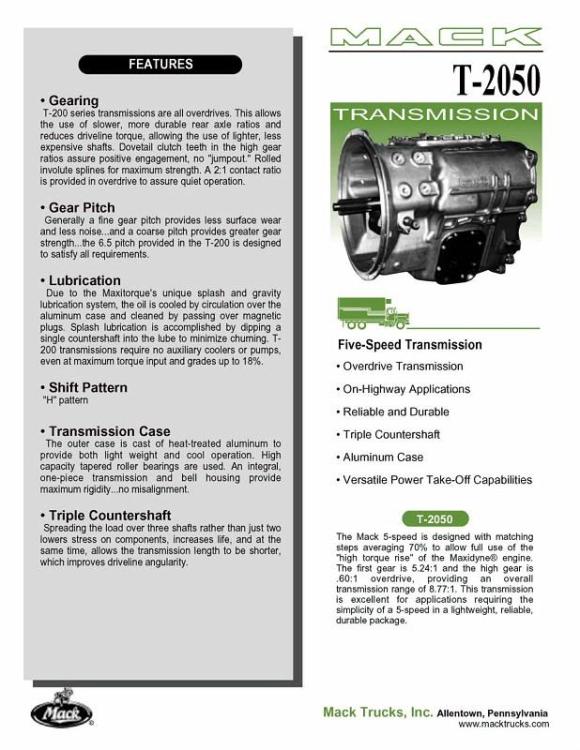
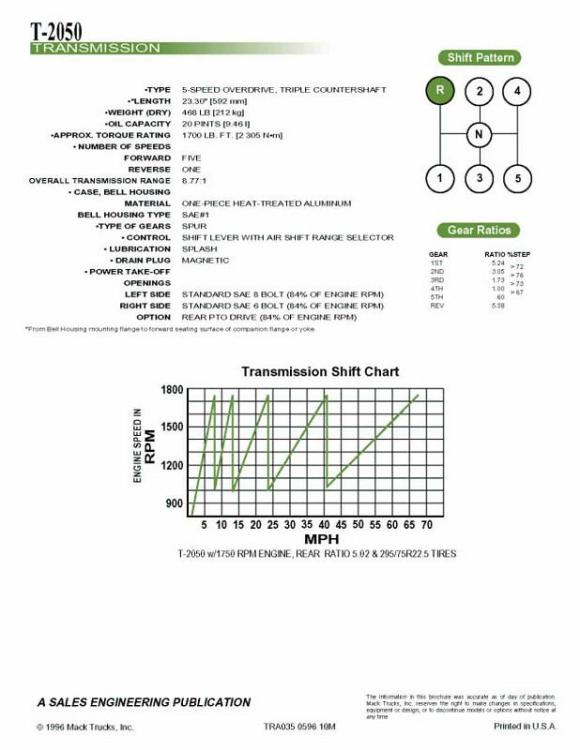
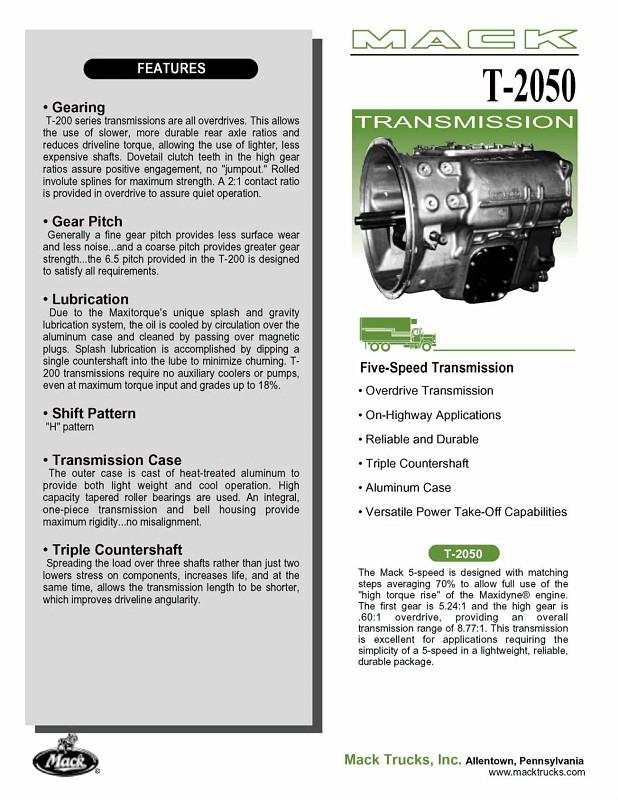
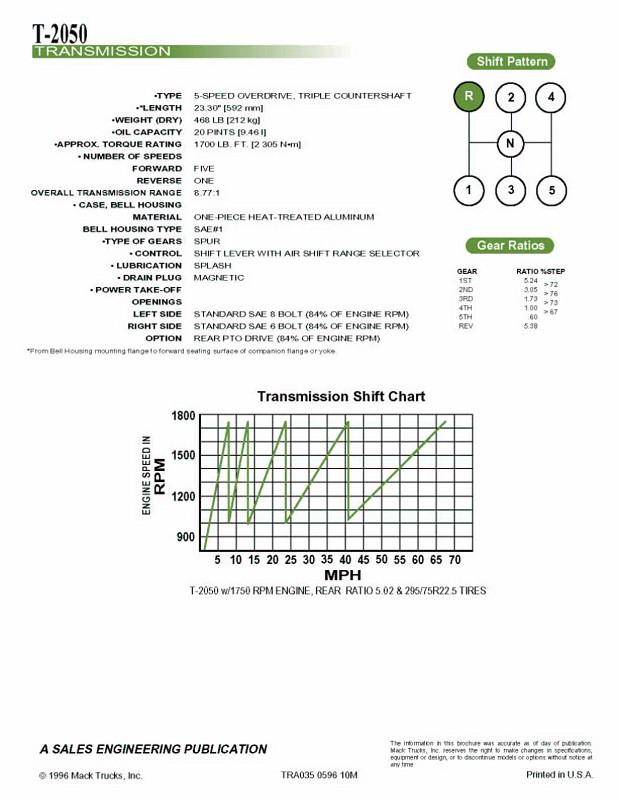
Funny thing but if we talk about Mack truck transmissions I have done only ONE swap to the moment. Took off T2090 and put T2070 in its place in a R-model. But I collected a bunch of different transmissions during the years and investigated many aspects of the matter. Of what I can tell answering the question above both TRL107 and T2050 would fit the flywheel housing of a E6 or EM6. Probably both have 2" thick input shaft with the same number of splines (10?). But T2070 (2070,2090 etc) seem usually combined with 15.5 inch clutch and T100 series units were fit to 14" setup. I don't know if is it possible to install T200 series unit using 14" clutch or not. But I can tell swapping the clutch would require swapping the flywheel since they were of different styles. The tranny mounts seemed not interchengeable since T200 used cast mounts and T100 were welded of thick steel. But chassis brackets look the same. So if you're going to put T2050 (2070 etc) into a R-model you just need a pair of tranny mounts for T200 used in a R-model with Mack in-line 6 cyl engine. Which seem as a pretty common part. Aside of that the prop shaft would need its length corrected (cut and balanced) and possibly another shifter lever found. If you're going to use T2050 which was taken off a R the lever would fit fine. But if the tranny goes off say a DM it would be found between your legs when put in a R-model cab. Another story is the very reason to use T2050. It has quite fast OD which would be good in a work truck combined with relatively slow rears. Something like 5.73. And also depending on the tyre size and sure the kind of job you're going to use it for. One more point to doubt over is T2050 is only 5 speed. And if you use T2070 or T2080 it would be almost the same amount of job and mods to install (and the same fast 0.60 OD) but a few additional crawl speeds which may be of use in many situations. Vlad
-
-
The 2nd and 3rd gears have the same ratios as in T2070. And also in T2060 and T2080. By the word I recently discovered that T2070 with short compound housing existed.
-
Coca Cola LJ Mack colors
Vladislav replied to 1961H67's topic in Antique and Classic Mack Trucks General Discussion
The color combo looks awesome! Hope the Superliner will pass the diff surgary well. -
What Model?
Vladislav replied to Bullheaded's topic in Antique and Classic Mack Trucks General Discussion
The truck in the 1st picture is definitely a LM. Heavy series L They were either made with center or offset cab. Many had 707 Mack EY gasser. Or different brand diesels. The matter of Canadian spread 60 inch bogie is better weight distribution I belive which allows carrying larger loads. I suggest though our Canadian members may share more detailed explanations on that. Thanks for posting these cool pictures! -
Coca Cola LJ Mack colors
Vladislav replied to 1961H67's topic in Antique and Classic Mack Trucks General Discussion
Many thanks for guiding! I'm already 12 years long involved into real Mack world (starting from the point I accuired the 1st truck) and have plenty of great contacts, activities, impressions and so on I wouldn't ever get if went a common life route. This hobby is a key to a special world. My doubts are just a matter of basic doubts as long as we better figure the way to go than just follow some path in the life. But accounting the things done in the recent years I too enjoy the way the time was spent. -
Best B-day wishes!
-
Hmm... I may agree with your terminology indeed. A transfer case is also a kind of power take off. But to a front drive axle usually (I think?) The unit in the R-model is of very similar style to what was used in fire trucks. anyway I'm going to remove it as well as extra fish plating and other mods put to the chassis. And I lean toward putting the bogie to its original position since the wheelbase still would be rather long. Quite enough to put a flat bed or even a sleeper.
-
Coca Cola LJ Mack colors
Vladislav replied to 1961H67's topic in Antique and Classic Mack Trucks General Discussion
Your attitude sounds happy on what you say about the current state of your life. It's really nice. Being at my age (47 now) and also earlier I may be count as your late dad in his time collecting "a first bunch of trucks" in my family. I try looking forward with guesses of do I right or not spending time on old stuff and resto projects. At all my considerations tell me I'm on the right way. And the words you shared on how you're currently doing are very helpful and optimistic.



BMT Forum Logo