


kscarbel2
-
Posts
19,127 -
Joined
-
Days Won
115
Content Type
Profiles
Forums
Gallery
Events
Blogs
BMT Wiki
Collections
Store
Everything posted by kscarbel2
-
-
Freightliner Trucks Press Release / February 22, 2018 Freightliner & Alliance Truck Parts combine forces to give car #14 a strong yellow and black look for 2018. .
-
.
-
Owner-Driver / February 26, 2018 All brands of truck are welcome at the Kyabram Mack Muster on March 17 and 18. Are Mack lovers the most passionate truck enthusiasts in Australia? Mangoplah mechanic Dave Willis thinks so. He’s anticipating a mammoth turnout for the 2018 Kyabram Mack Muster on March 17 and 18, 2018. Dave is organising the event with Tim Daws and John Laffan, in conjunction with the Kyabram Vintage Engine & Machinery Restoration Group’s annual rally. The muster takes place at the Kyabram Showgrounds, Kyabram, in the Goulburn Valley, Victoria – about 40km from Shepparton. The showground gates will open on Friday, March 16, for those determined not to miss any of the weekend action. And a barbecue will be held at the showgrounds on Friday night. Dave is still deciding which of his many Macks he will polish up for the muster – probably a Flintstone, Super-Liner and a couple of F models. The oldest Mack at the muster will possibly be David Daws’ 1923 AC. But Dave Willis says the event is not just for old Macks. "It’s open to all ages and conditions of Macks. And in fact it’s open to all makes of truck as well – not just Macks." Kyabram local, Jim Ristovichis, plans to take his Super-Liner, ‘Fruit Express’. Jim bought Fruit Express in the late 1980s and the Super-Liner won about 17 truck show trophies when it was new. It has had five other owners since then. Jim bought it back recently and is determined to have a major restoration completed in time for the muster. Bookings are essential for the official dinner on Saturday night which will feature guest speakers with a wealth of knowledge about Mack trucks. Dave warns the dinner will possibly be booked out before the weekend. For more information about the Mack Muster, phone Dave Willis (0428 692 753), John Laffan (0427 484 247) or Tim Daws (0458 868 988); or visit the Kyabram Mack Muster Facebook page.
-
Kenworth rolls out new 610 sleeper cab Owner-Driver / February 28, 2018 Following last year's release of the T610 and T610SAR, Kenworth has announced a 760mm mid roof sleeper cab option, complementing the existing day and 860mm sleeper cab. The new sleeper cab option is aimed a range of customers, including those using the T610 for 19m tippers, tankers, and 19m B-double applications. Kenworth spent ten years designing the new cab with a focus on the needs of the driver, offering better walthrough access, more storage, better ergonomics and more. "The core of the T610 project was about building a bigger cab to create the ultimate driver environment, which leads to better all-round driving performance, safety, efficiency and productivity" said PACCAR Australia’s Director of Sales and Marketing Brad May. "This 760mm sleeper cab option allows even greater flexibility for our customers whose applications demand it. The mid roof allows access under gantries and suits many height restricted truck and trailer combinations and provides an additional 90mm of head room than the day cab." The T610 interior is designed to offer the driver a more open and relaxed cabin that's easier to move around in and rest during breaks. The new mid-roof sleeper offers an inner spring mattress with hinged pan for under bunk storage, optional under bunk fridge and open shelving as standard. Kenworth also focused on optimising the shape and surfaces over the sleeper cab roof to improve the aerodynamics and clearance.
-
New Cab From Kenworth Diesel News AU / March 2018 In an extension of the range options, a new cab from Kenworth will increase the options for customers looking at the T610 and T610SAR. Kenworth have announced the release of a 760mm mid roof sleeper cab, adding to the existing options of a day and 860mm sleeper cab. According to Kenworth, the new sleeper cab option will be suitable for many different applications including 19m tippers, tankers, and 19m B-double applications. The new cab, as released last year and now with added options, can be seen as a game changer for Kenworth. In the past each model in the range had a different cabin design. Now, with the T610 variations a common platform can be rolled out across a larger part of the range with common characteristics. The design incorporates more foot space and storage, a wider walkthrough access between the seats and more door and windscreen glass. The improvements provide space, visibility and ergonomics which were not there in Australian Kenworth trucks in the past. “The core of the T610 project was about building a bigger cab to create the ultimate driver environment, which leads to better all-round driving performance, safety, efficiency and productivity” said Brad May, Paccar Australia’s Director of Sales and Marketing. “This 760mm sleeper cab option allows even greater flexibility for our customers whose applications demand it. The mid roof allows access under gantries and suits many height restricted truck and trailer combinations and provides an additional 90mm of head room than the day cab.” Significantly wider and with increased walkthrough space between seats and greater room head-to-toe for the driver, the T610 interior delivers the driver a more open and relaxed cabin that is far easier to move around in and rest during breaks. The new mid roof sleeper offers an inner spring mattress with hinged pan for under bunk storage, optional under bunk fridge and open shelving as standard. Back at the original T610 launch, the time had come for the conventional truck in Australia to bring itself up to date. Modern electronics and assembly technology have introduced many new possibilities. The modern truck owner is also looking for a lot more from each truck in terms of productivity, information as well as driver safety and comfort. The Paccar group, as a whole, is moving towards a unified cabin design and Kenworth in Australia have come up with their unique adaptation as the T610. However, we must not forget, this is Kenworth, a very careful and conservative brand, with conservative customers, who are willing to embrace change, but not too much in one go. The T 610 seems to have hit just the right balance of old and new to keep most people happy. To begin with, the chassis remains unchanged. This is a tough and reliable set up, undergoing constant customisation, which the industry has come to rely on. The driveline is also little changed, in the actual metal, but the integration between the truck’s electronics, the Cummins Engine and Eaton transmission will further enhance its reputation. The cabin itself is changed and is a combination of three basic sections. The driver compartment is the Paccar group design used in Kenworth and Peterbilt product in the US, but adapted and beefed up for our conditions. The sleeper is a traditional design built in the same way as all of the current Kenworth cabs. These two come together under a newly-designed roof, to pull the whole design together.
-
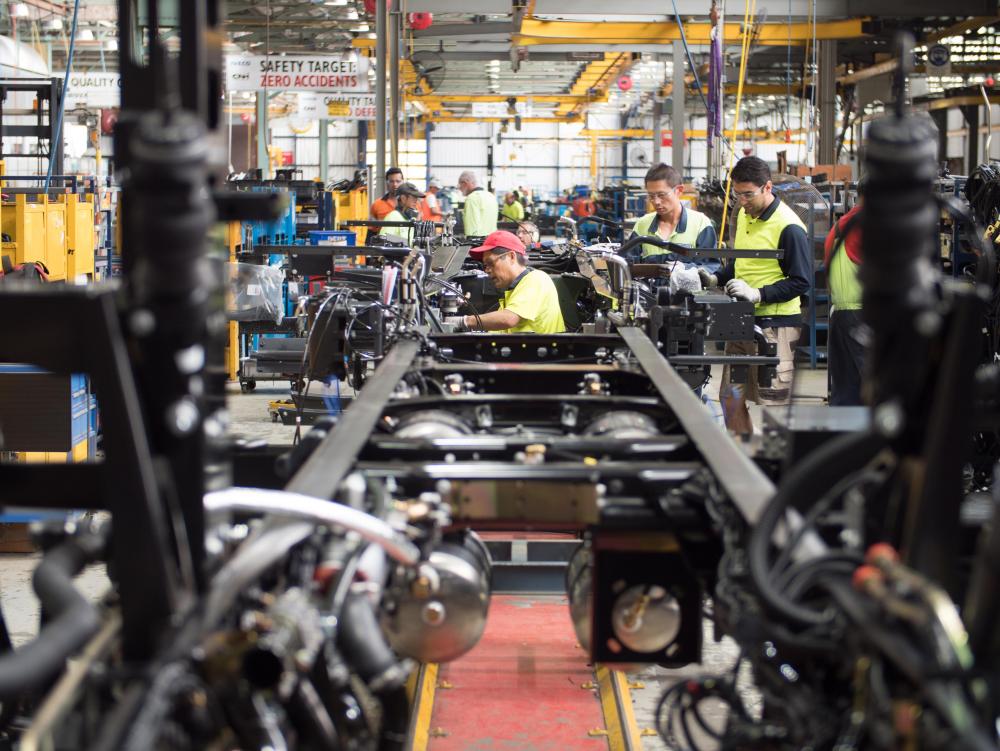
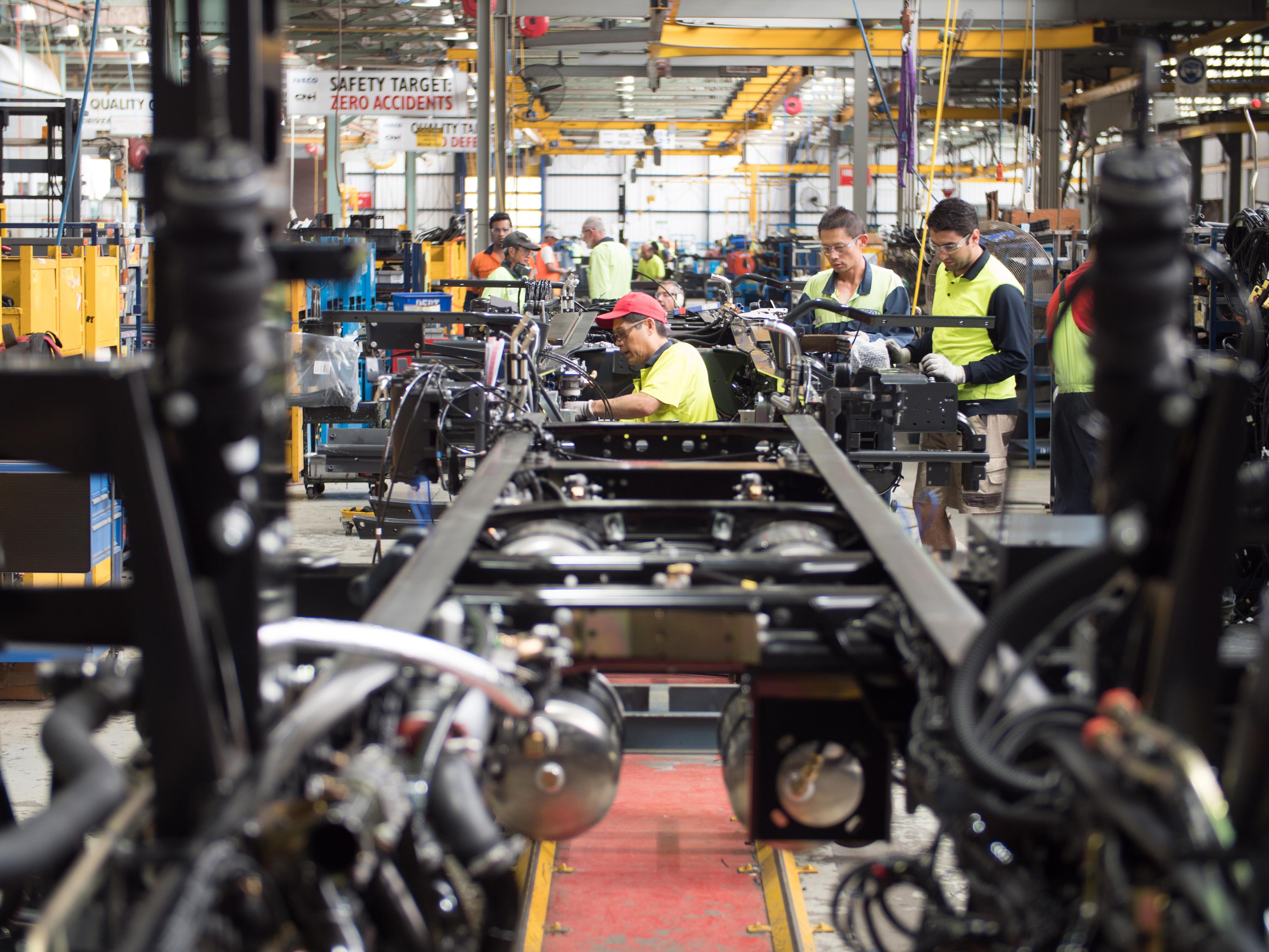
Prime Mover Magazine / March 1, 2018 Commercial vehicle manufacturer, Iveco, has commented on the local assembly of the Stralis ATi model, following a manufacturing boost at its facility in Dandenong, Melbourne. According to Iveco, selected components including mirrors, wheel angles, trailer connections, batteries, wheels and liquids are now all sourced locally. The addition of the Stralis AT to the local production mix has also seen the Dandenong facility undergo investment in tooling and software to calibrate the AT’s adaptive cruise control and lane departure warning systems, and in doing so introduced new technology to the site that could also be used for other models in the future. “Australian buyers will enjoy several benefits from the local production of AT models including greatly reduced lead times from vehicle order to delivery, and the ability to customise to order by adding factory-fitted special options and local accessories,” Iveco said in a statement. Iveco’s local engineers are also working on the installation of new Euro 6-rated Cursor engines for both the AT and AS-L variants. The Australian engineering team is continuing its real market testing on a selection of these engines. Iveco Australia Marketing Manager, Darren Swenson, said the increase in local production and development highlighted the company’s commitment to Australian manufacturing. “Iveco is one of few truck brands that continue to manufacture here – this latest expansion in Australian-based production demonstrates the company’s commitment to having a strong local manufacturing presence,” said Swenson. “The addition of Stralis AT variants to the local production mix along with the validation of new power plants and other initiatives is great news for the local workforce and our third-party parts suppliers but also for Australian truck buyers who can further reap the benefits that locally-manufactured vehicles provide. “The expansion of local production not only reflects a strong belief from Iveco Australia that local manufacturing is sustainable, but the initiative is also strongly supported by Iveco’s parent company, CNH Industrial,” he said. The Stralis AT and AS-L ranges join several other of Iveco’s locally-manufactured models including the ACCO – which has been built in Dandenong for over 40 years – and Delta and Metro bus chassis. .
-
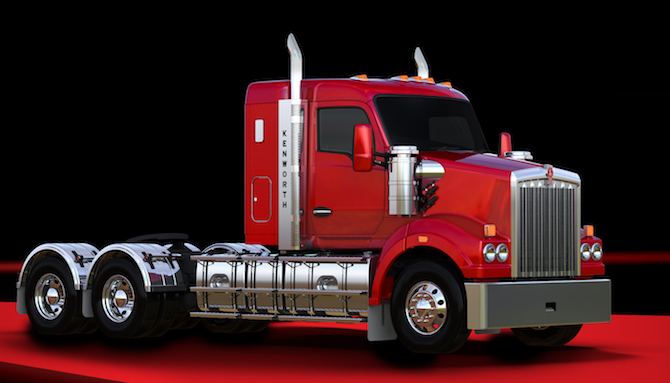
Prime Mover Magazine / March 1, 2018 Commercial vehicle manufacturer, Kenworth, has released a 760mm mid roof sleeper cab, following the introduction of the T610 and T610SAR last year According to Kenworth, the new sleeper cab is suitable for many different applications including 19m tippers, tankers, and 19m B-double applications. “The core of the T610 project was about building a bigger cab to create the ultimate driver environment, which leads to better all-round driving performance, safety, efficiency and productivity” said PACCAR Australia Director of Sales and Marketing, Brad May. “This 760mm sleeper cab option allows even greater flexibility for our customers whose applications demand it. “The mid roof allows access under gantries and suits many height-restricted truck and trailer combinations and provides an additional 90mm of head room than the day cab,” he said. Significantly wider and with increased walkthrough space between seats and greater room head-to-toe for the driver, the T610 reportedly provides vehicle operators a more open and relaxed cabin that is far easier to move around in and rest during breaks. The new mid roof sleeper offers an inner spring mattress with hinged pan for under bunk storage, optional under bunk fridge and open shelving as standard. .
-
You purchased an extended warranty for $5,000, but received no paperwork (certificate) on it? Nextran is a good outfit. Owner Jon Pritchett is good people. At any rate, if Nextran can't resolve your concern, I suggest you contact Mack brand customersatisfaction at +1 (866) 298-6586 for further assistance.
-
Western Star Press Release / March 2, 2018 .
-
Western Star Press Release / February 16, 2018 .
-
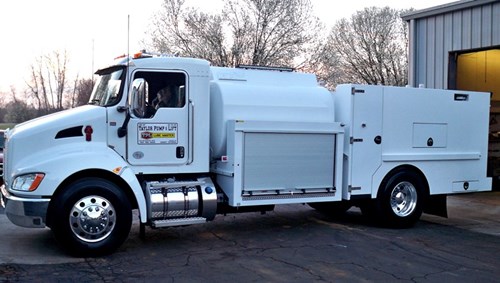
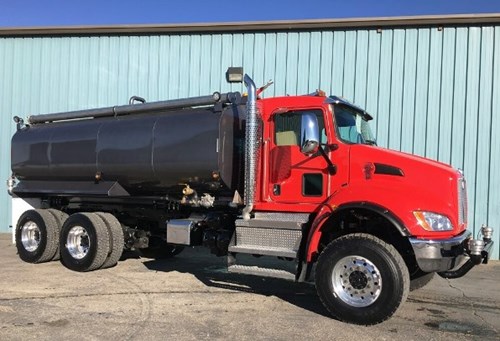
Kenworth Truck Co. Press Release / March 1, 2018 Kenworth Truck Company will offer the latest information on its industry leading vocational truck lineup during The Work Truck Show March 6-9 in Indianapolis, Indiana. The event is sponsored by the National Truck Equipment Association (NTEA). “Kenworth is coming to The Work Truck Show with a wide range of products that highlight the excellent performance, durability and reliability, and low operating cost Kenworth delivers across the vocational market,” said Kurt Swihart, Kenworth marketing director. The Kenworth truck lineup (booth #1401) is led by the set-forward front axle Kenworth T880S Jerr-Dan 25-ton wrecker with PACCAR MX-13 engine, and a Kenworth T880 Vactor Guzzler®. In addition, there are four medium duty Kenworth T370s – a TPL (Taylor Pump & Lift) lube truck, Valew water tanker, and Summit service body, all specified with a PACCAR PX-9 engine; and an Altec Aerial vehicle with the PACCAR PX-7 engine. Kenworth will offer a “Kenworth Chassis Update” from 8 a.m. to 9:15 a.m. in the Wabash 2 room Wednesday, March 7. The informative product session will offer insights into Kenworth’s vocation-specific options to help optimize body and equipment installation and designs. .
-
Bloomberg / March 3, 2018 Volkswagen AG officials are discussing options to prepare the truck division for access to the capital markets, potentially paving the way for an initial public offering of shares or a bond sale by the unit, according to people familiar with the matter. Deliberations at a meeting last week included changing the division’s legal structure to a private limited company under German rules or the European equivalent Societas Europaea, said the people, who asked not to be identified as the talks are confidential. A decision could be made in the next few weeks, but the discussions are complex and might drag on, according to the people. “Currently we are focusing on implementing our strategy and on driving the transition from a ‘start-up company’ into a mature corporation," VW’s truck unit said in an emailed statement on Saturday, adding that “we keep all options open.” Global automakers have embarked on sweeping organizational changes as the industry faces a seismic shift toward electric vehicles, autonomous cars and new digital services such as ride hailing. Granting the VW truck operation more independence within the world’s largest automaker would help to build confidence among investors that VW is considering deeper organizational changes to become more efficient in the wake of the diesel-emission scandal that erupted in September 2015. Less Centralized The German company embarked on a push to become less centralized as part of a new strategy, but an asset review announced almost two years ago to identify non-core operations hasn’t led to a tangible results so far. The push to make the 630,000-employee, 120-factory group more focused on its main automotive operations appeared mired in internal politics last year when the sale of the Ducati motorcycle brand collapsed. German rival Daimler AG last year firmed up plans to give individual units more independence to make them agile. The move sparked speculation that the manufacturer could spin off its truck division, which is the world’s largest maker of commercial vehicles. Daimler officials have denied that a full sale of a division is in the works, but left the door open for a possible initial public offering of a minority stake. VW’s truck division has struggled to generate cost synergies after the carmaker bought Munich-based MAN SE and Sweden’s Scania AB. After VW hired Andreas Renschler from Daimler, he pushed deeper cooperation within the division, which also sells VW-brand heavy trucks in Brazil. The company aims to create a rival to global commercial vehicle leaders Daimler and Volvo AB. Scania and MAN combined generate about 25 billion euros ($29 billion) in annual revenue and produce vehicles ranging from the Swedish brand’s long-haul R-Series featuring V8 engines to MAN’s mid-duty trucks and TGE vans. Renschler has set his sights on further expansion. He spearheaded the acquisition of a 17 percent stake in Navistar International Corp. to gain a foothold in the U.S. He’s also considering strengthening ties with China’s Sinotruk Hong Kong Ltd. and is in cooperation talks with GAZ PJSC in Russia.
-
International Trucks Press Release / February 27, 2018 ERL Trucking testimonial of the A26 Engine and LT Series from International Trucks. .
-
Here are all six things the 2019 GMS Sierra’s Wild MultiPro tailgate can do Tony Markovich, Car & Driver / March 2, 2018 The major news from GMC’s unveiling of the new 2019 Sierra pickup truck included the announcement of a turbo-diesel 3.0-liter inline-six and a bed that incorporates carbon-fiber-reinforced plastic paneling. But the flashiest, coolest, and most fun part of the new Sierra is the MultiPro tailgate, which smartly incorporates various built-in hinges to help with ingress and egress, load stopping, second-tier loading, and access to the bed. Allow us to explain how it all works. GMC touts the MultiPro’s six different functions, but that includes the normal up-and-down movement of the whole tailgate, so, um, okay. It’s damped for slow opening, which can be done by hand or by two clicks on the remote. Within the full tailgate is a secondary cutout that extends to within a few inches of either side and stops at the space just below the large GMC logo. On the inside of this cutout is another flap that can hinge up and out toward the rear of the truck. With the tailgate folded down, that inside flap can be deployed in various ways, including as a stopper for an extended load. Technically, there is no physical tailgate handle. The operations are controlled by two buttons that are stacked in between two camera lenses, where you would expect a conventional release. Press only the top button, and the main tailgate remains closed, while the small cutout (which GMC calls the inner gate) hinges down via two swing arms and stops parallel to the ground to make a tablelike standing workspace. In this configuration, the back flap can be unfolded to act as a load stopper for extended second-tier loading above the wheel wells. As an example, GMC cited large sheets of plywood above other cargo. The inner gate serves other functions as well. Press the bottom button to let the tailgate down, then press the top button to let the cutout down. This allows people to step into the space where the tailgate normally is, and it gives users easier access to the bed for loading or unloading cargo. Taking it one step further, the aforementioned flap can be unfolded while both the tailgate and the cutout are let down, creating a stairway into the bed (it can take up to 375 pounds of human weight). In this position, the main part of the tailgate can be used as a place to sit with a footrest, and the sides of the main gate even have “cupholder” indents. The final piece of this do-everything package is not part of the tailgate itself. GMC attached a black handle bar to the driver’s side of the inner bed, which stows in a vertical position. Unlock the bar from the bottom, and it hinges at the top, eventually locking in a diagonal position (not pictured). This provides a convenient handhold to aid those stepping up into the bed of the truck. The whole thing is pretty cool, seems extremely well thought out, and should be quite useful. The MultiPro tailgate is standard on both SLT and Denali models, the only trim levels GMC has revealed so far. We’re guessing it could be offered as an option on less pricey models, but the company won’t talk about those yet. Those who are still skeptical can try it out in person when the 2019 GMC Sierra hits dealerships in the fall. .
-
Ford to retool Michigan Assembly in May-October for Ranger, Bronco Michael Martinez, Automotive News / March 2, 2018 DETROIT — Ford Motor Co. will idle its Michigan Assembly Plant in suburban Detroit for more than five months starting in May, temporarily laying off 2,000 hourly workers while it retools the plants to build the 2019 Ranger pickup. The Wayne, Mich., plant will reopen Oct. 22 for Ranger production, according to a filing with the state of Michigan. Ford will end production of the Focus sedan and C-Max Hybrid crossover May 7, the automaker said in a notice in compliance with the federal Worker Adjustment and Retraining Notification Act. All affected employees will either return to the plant in October or transfer to another plant. During the downtime, the workers, represented by the UAW, will receive roughly 75 percent of their normal pay if they have at least one year of seniority. In a statement, Ford stressed that the move was a "temporary measure." The Detroit News reported the WARN notice filing Friday afternoon. Ford had not previously revealed specific details about the timing of the changeover, saying only it would end car production at Michigan Assembly in mid-2018. Ford ended production of the C-Max Energi, a plug-in hybrid, late last year. Ford unveiled the 2019 Ranger at the Detroit auto show in January. It has not released details about the Bronco SUV, which will be assembled alongside the Ranger and go on sale in 2020.
-
Run the exhaust through the dump body. Note the exhaust split and the spring-loaded mating flange...............http://eng.grunwaldtrailers.ru/news/17/new-grunwald-tipper-bodies-for-the-russian-market/
-
Truck News / March 2, 2018 DENTON, Texas – Peterbilt has announced several rebates for 2018 customers. Members of the Owner-Operator Independent Drivers Association (OOIDA) are entitled to a cash rebate of $1,500 when they buy a Model 579, 567, or 389 spec’d with a sleeper. Members of Landstar are being offered the same cash rebate. “OOIDA and Landstar and their owner-operator members are a vital piece of trucking in the U.S. and Canada and we are proud that Peterbilt remains their truck of choice,” said Robert Woodall, assistant general manager, sales and marketing, Peterbilt Motors Company. “As part of our ongoing support of these organizations and their members we are pleased to offer these rebates as a thank you for their continued loyalty and enthusiasm for the Peterbilt brand.” Members must be in good standing with OOIDA or Landstar for a minimum of 90 days prior to delivery. Rebate checks will be mailed directly to the customer from Peterbilt. Customers are limited to three rebates per calendar year and rebates cannot be combined with any other offers directly from Peterbilt. The truck maker also announced vocational customers who belong to the National Ready Mixed Concrete Association (NMRCA) or the American Logger Council (ALC) qualify for a $2,000 cash rebate when purchasing a Model 567 or 520 (567 only for ALC members). “Peterbilt’s vocational customers demand the most rugged and reliable trucks available,” said Woodall. “We are confident that customers in need of these trucks will proudly choose Peterbilt time and time again. Peterbilt is pleased to support their loyalty by offering these rebates.” Rebate checks are mailed directly to the customer from Peterbilt and customers are limited to three rebates per calendar year. These rebates may not be combined with any other offer directly from Peterbilt. Customers can expect rebates to take 6-8 weeks to process. Members must be in good standing with ALC or NRMCA for 90 days prior to taking delivery.
-
Trump invites 'easy to win' trade war as tariff anger spreads Bloomberg / February 2, 2018 WASHINGTON -- President Donald Trump invited a trade war after slapping tariffs on steel and aluminum imports, daring other countries to act on threats of retaliation. “When a country (USA) is losing many billions of dollars on trade with virtually every country it does business with, trade wars are good, and easy to win,” Trump said in an early morning tweet on Friday. Trump is facing anger from manufacturers and trade partners in China and Europe after announcing tariffs of 25 percent on imported steel and 10 percent on aluminum for “a long period of time.” The formal order is expected to be signed next week. U.S. Sen. Ben Sasse, R-Neb., cautioned “Trade wars are never won. Trade wars are lost by both sides,” in a statement. “If the President goes through with this, it will kill American jobs -- that’s what every trade war ultimately does. So much losing.” Trump in a follow-up tweet Monday morning warned of more trade actions ahead, casting them as reciprocal taxes, a term he has used for imposing levies on imports from countries that charge higher duties on U.S. goods than the U.S. currently charges. “We will soon be starting RECIPROCAL TAXES so that we will charge the same thing as they charge us. $800 Billion Trade Deficit-have no choice!” Trump said in the tweet. The aggressive stance has stoked fears of trade retaliation and roiled global markets. The U.S. dollar weakened for a second day against a basket of currencies, while equity markets across the U.S., Asia and Europe have declined. Trump hasn’t given the details of his proposed action on steel and aluminum tariffs, including whether any products or countries would be exempted. The planned tariffs, justified on the basis that cut-price metals imports hurt both American producers and national security, now raise the prospect of retaliatory curbs on American exports and higher prices for domestic users. While the practical impact may yet turn out to be limited, the political environment for global trade has just taken a turn for the worse. European equities followed Asian markets lower on Friday after losses in the U.S. the day before. Asian stocks had already built on losses seen in the U.S. the previous day, with shares in Hong Kong, Japan, China, Australia and South Korea weaker. Separately, the yen spiked and Japanese assets slumped after Bank of Japan Governor Haruhiko Kuroda discussed the timing of a possible exit from its stimulus policy in parliament. The official response in China, the world’s largest steel producer, was muted. Foreign Ministry spokeswoman Hua Chunying merely said in Beijing Friday that China urges the U.S. to follow trade rules. Industry insiders were less restrained. The U.S. measures “overturn the international trade order,” Wen Xianjun, vice chairman of the China Nonferrous Metals Industry Association, said in a statement. “Other countries, including China, will take relevant retaliatory measures.” Li Xinchuang, the vice chairman of China Iron and Steel Association, called the move “stupid.” U.S. allies, seeing their industries threatened, responded with bafflement and dismay. Some also panned the idea that metals imports pose a threat to national security. “Steel and aluminum imports from Japan, which is an ally, do not affect U.S. national security at all,” Japan’s Trade Minister Hiroshige Seko told reporters in Tokyo Friday. “I would like to convey that to the U.S. when I have an opportunity.” Toyota Motor Corp., which plans to build a new $1.6 billion factory in Alabama with Mazda Motor Corp., said the administration’s decision will “adversely impact” auto companies by raising costs and prices of cars and trucks sold in the U.S. That’s even as more than 90 percent of the steel Asia’s biggest carmaker needs in the U.S. is from the country. Trade groups representing automakers including General Motors and Toyota, plus parts suppliers like Robert Bosch GmbH, tried to warn the Trump administration of unintended consequences before Thursday's announcement. Asian automakers’ shares declined while U.S. carmakers -- already slipping because of weak February sales -- extended their drop after Trump’s comments. “These proposed tariffs on steel and aluminum imports couldn’t come at a worse time,” said Cody Lusk, president of the American International Automobile Dealers Association. “Auto sales have flattened in recent months, and manufacturers are not prepared to absorb a sharp increase in the cost to build cars and trucks in America.” Some automakers contacted by Automotive News before Thursday downplayed the potential effect of the proposed import limits on their operations, saying they use very little imported steel and aluminum. Ford sources 95 percent of its steel and 98 percent of its aluminum from domestic mills, spokeswoman Christin Baker said. The company is a large buyer of lighter-weight aluminum, which it began using in recent years in body panels for F-series pickups and large SUVs. Mark Reuss, global product chief at General Motors, said 90 percent of GM's steel is sourced from the United States. “But whatever happens on those trade policies, we’ve got to be ready to defend and be disciplined around how we buy and how we develop and engineer," he said later Thursday. "That’s why taking a mixed material approach on some of these is a great hedge as well." Canada reaction Canada -- the biggest foreign supplier of steel and aluminum to the U.S. -- said the measures were unacceptable while the European Union vowed to “ react firmly” with World Trade Organization-compliant countermeasures in the next few days. Australian Trade Minister Steve Ciobo called the move “disappointing” and said his country is seeking an exemption. The punitive measures would level the unfair playing field that has persisted for years, and make it easier for American companies to expand and hire workers, Trump said. U.S. companies from beer brewer MillerCoors to candymaker Hershey Co., which use aluminum for manufacturing and packaging, said operations would be hurt by the tariffs. “We buy as much domestic can sheet aluminum as is available, however, there simply isn’t enough supply to satisfy the demands of American beverage makers like us,” MillerCoors said in a tweet. “American workers and American consumers will suffer as a result of this misguided tariff.” Soybean response A U.S. move on tariffs risks provoking retaliation, particularly from Beijing. China has already launched a probe into U.S. imports of sorghum, and is studying whether to restrict shipments of U.S. soybeans -- targets that could hurt Trump’s support in some farming states. While China accounts for just a fraction of U.S. imports of the metals, it’s accused of flooding the global market and dragging down prices. What Our Economists Say... “China’s total exports of steel and aluminum are equal to about 0.5% of GDP, most of that from steel,” said Bloomberg’s Chief Asia Economist Tom Orlik. “Relative to fears from Trump’s campaign trail rhetoric, in which he threatened an across-the-board 45% tariff on all imports from China, these measures are extremely limited.” Trump announced the tariffs despite lobbying of his administration by foreign governments, and while Chinese President Xi Jinping’s top economic adviser is in the country on a mission to defuse tensions. The impact of the step hinges in part on which nations will be affected, said Alex Wolf, senior emerging markets economist at Aberdeen Standard Investments in Hong Kong, who previously worked at the U.S. State Department. “It’s not much ado about nothing,” he said. "But until we see the final scope of the tariffs and the response from global trading partners it’s hard to say it’s the start of a tit-for-tat trade war."
-
3MT247 is the Mack part number for the smaller later pyrometer gauge. https://m.ebay.com/itm/Pyrometer-Gauge-Kit-PAI-P-N-FPK-0473-Ref-Mack-85131532-3MT247-39MR2410-64MT324-/252570036049 1MT315P1 is the Mack part number for the older large pyrometer gauge.
-
I expect it to be.
-
Yes.
-
Hyliion Offers Week-Long Tests of its Hybrid Tractors
kscarbel2 replied to kscarbel2's topic in Trucking News
. -
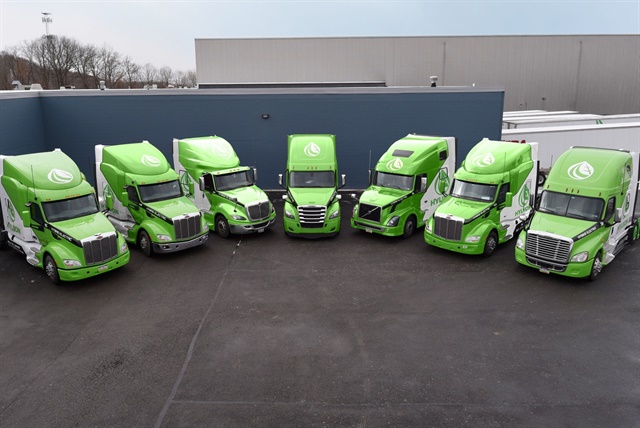
Heavy Duty Trucking (HDT) / March 1, 2018 Hyliion, which produces a hybrid electric axle system for Class 8 trucks, has created a trial fleet of trucks equipped with its 6x4HE system to allow fleets to test the vehicles out for free. The trial fleet is available for potential customers to test in their own operations for up to a week without any charge. Fleets will be able to use the electric-axle-equipped trucks in their daily operations to see if the trucks can actually work for them. Hyliion says that its technology can reduce fuel consumption and emissions by up to 30%. "We are excited to offer our customers the chance to test a Hyliion-enabled vehicle in their own day-to-day business operations," said Thomas Healy, Hyliion CEO and founder. “It is a big decision to adopt a new technology and the opportunity to take the truck for a trial run makes all the difference.” Hyliion will be showcasing its trial trucks at the Technology & Maintenance Council’s Annual Meeting & Transportation Technology Exhibition March 5-8 in Atlanta, Georgia. The trial trucks will be available to fleets starting March 12, and can be reserved through email trialtruck@hyliion.com, Hyliion’s website, or by calling 1-833-HYLIION. "The conclusion of the conference, these trucks will hit the road and be in customer hands," said Healy. “Our team is thrilled to offer this unique trial program.” . Hyliion will be showcasing its trial trucks at the Technology & Maintenance Council’s Annual Meeting & Transportation Technology Exhibition March 5-8 in Atlanta, Georgia. The trial trucks will be available to fleets starting March 12, and can be reserved through email trialtruck@hyliion.com, Hyliion’s website, or by calling 1-833-HYLIION. "The conclusion of the conference, these trucks will hit the road and be in customer hands," said Healy. “Our team is thrilled to offer this unique trial program.”
-
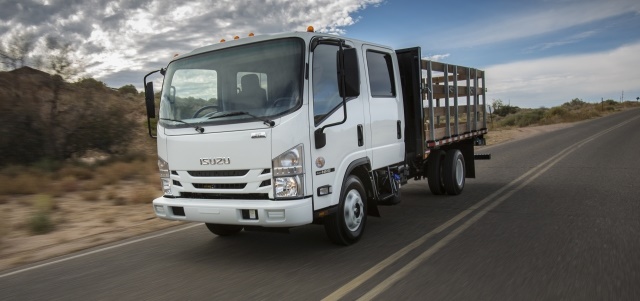
Heavy Duty Trucking (HDT) / March 1, 2018 Isuzu Commercial Truck of America, Inc. will offer a crew cab version of its Class 5 NRR cabover that will carry up to seven passengers. The NRR Crew Cab will have a 19,500-pound GVWR, Isuzu announced. “Last year, we unveiled our Class 6 FTR truck, which is already making major inroads in the marketplace,” said Shaun Skinner, president of Isuzu Commercial Truck of America and Isuzu Commercial Truck of Canada. “Now, we’re expanding the lineup even further with the introduction of a Crew Cab model in our Class 5 NRR series. This is further proof that Isuzu is committed to providing the right truck for every one of our customers’ needs.” Isuzu also announced additional details about its 2018 and 2019 model trucks. Highlights include: The only low-cab-forward lineup that includes two EPA-certified diesel engines and a gasoline engine alternative. Isuzu’s class-leading 5.2L Isuzu 4HK1-TC diesel engines provide B10 service life durability of 375,000 miles. Support features that help reduce operating costs, improve performance, manage risk and help protect owners’ truck investment. Cab/chassis combinations offer standard three-seat cabs or Crew Cabs with seating for a seven-person crew. Upfit applications accommodate vocational bodies up to 30 feet with the standard cab and 16 feet with Crew Cab models. GVWRs from 12,000 pounds to 25,950 pounds. N-Series Gas models feature a Vortec gasoline engine that is CNG/LPG alternative-fuel capable Production plans and key features for each of the available models: 2018 Isuzu NPR Gas Production began in January 2018. GVWR: 12,000 lbs. (class 3) Wheelbases: 109-176 inches with body lengths up to 20 feet. Powertrain: VortecTM 6.0-liter V8 gasoline engine generating 297 hp @ 4,300 rpm and 372 lb.-ft. of torque at 4,000 rpm mated to 6L90 Hydra-Matic 6-speed automatic with double overdrive. Available with a CNG/LPG alternative-fuel-capable option. Crew cab option for up to seven passengers. 2018 Isuzu NPR-HD Gas Production began in January 2018. GVWR: 14,500 pounds (Class 4) Wheelbases: 109-176 inches with body lengths up to 20 feet. Powertrain: VortecTM 6.0L V-8 gasoline engine generating 297 hp @ 4,300 rpm and 372 lb.-ft. of torque at 4,000 rpm mated to 6L90 Hydra-Matic 6-speed automatic with double overdrive. Available with a CNG/LPG alternative-fuel-capable option. Crew cab option for up to seven passengers. 2018 Isuzu NPR Diesel Production began in November 2017. GVWR: 13,000 pounds (Class 3). Wheelbases: 109-176 inches with body lengths up to 20 feet. Powertrain: Isuzu 3.0-liter 4JJ1-TC turbocharged intercooled four-cylinder diesel engine with a B10 durability rating of 310,000 miles generating 150 hp @ 2,800 rpm and 282 lb.-ft. of torque at 1,600–2,800 rpm mated to an Aisin A460 double overdrive 6-speed automatic transmission with lockup torque converter. Isuzu’s exclusive IDSS (Isuzu Diagnostic Service System) allows diesel-model owners to receive a detailed “Health Report” from Isuzu dealers on performance data. 2019 Isuzu NPR-HD Production began in January 2018. GVWR: 14,500 pounds (Class 4). Wheelbases: 109-176 inches with body lengths up to 20 feet. Powertrain: Isuzu 5.2L 4HK1-TC turbocharged intercooled four-cylinder diesel engine with a B10 durability rating of 375,000 miles generating 215 hp @ 2,500 rpm and 452 lb.-ft. of torque at 1,850 rpm mated to an Aisin A465 6-speed double overdrive automatic transmission with lockup torque converter plus PTO opening. Isuzu’s exclusive IDSS (Isuzu Diagnostic Service System) allows diesel-model owners to receive a detailed “Health Report” from Isuzu dealers on performance data. Crew Cab option for up to seven passengers. 2019 Isuzu NPR-XD Production began in January 2018. GVWR: 16,000 pounds (Class 4). Wheelbases: 109-176 inches with body lengths up to 20 feet. Powertrain: Isuzu 5.2L 4HK1-TC turbocharged intercooled four-cylinder diesel engine with a B10 durability rating of 375,000 miles generating 215 hp @ 2,500 rpm and 452 lb.-ft. of torque at 1,850 rpm mated to an Aisin A465 6-speed double overdrive automatic transmission with lockup torque converter plus PTO opening. Isuzu’s exclusive IDSS (Isuzu Diagnostic Service System) allows diesel-model owners to receive a detailed “Health Report” from Isuzu dealers on performance data. Crew Cab option for up to seven passengers. 2019 Isuzu NQR Production began in January 2018. GVWR: 17,950 pounds (Class 5) Wheelbases: 109-200 inches with body lengths up to 22 feet. Powertrain: Isuzu 5.2L 4HK1-TC turbocharged intercooled four-cylinder diesel engine with a B10 durability rating of 375,000 miles generating 215 hp @ 2,500 rpm and 452 lb.-ft. of torque at 1,850 rpm mated to an Aisin A465 6-speed double overdrive automatic transmission with lockup torque converter plus PTO opening. Isuzu’s exclusive IDSS (Isuzu Diagnostic Service System) allows diesel-model owners to receive a detailed “Health Report” from Isuzu dealers on performance data. Crew Cab option for up to seven passengers. 2019 Isuzu NRR Production began in January 2018. GVWR: 19,500 pounds (Class 5). Wheelbases: 109-212 inches with body lengths up to 24 feet. Powertrain: Isuzu 5.2L 4HK1-TC turbocharged intercooled four-cylinder diesel engine with a B10 durability rating of 375,000 miles generating 215 hp @ 2,500 rpm and 452 lb.-ft. of torque at 1,850 rpm mated to an Aisin A465 6-speed double overdrive automatic transmission with lockup torque converter plus PTO opening. Isuzu’s exclusive IDSS (Isuzu Diagnostic Service System) allows diesel-model owners to receive a detailed “Health Report” from Isuzu dealers on performance data. New Crew Cab option for up to seven passengers. 2019 Isuzu FTR Production begins in March 2018. GVWR: 25,950 pounds (Class 6). Wheelbases: 152-248 inches with body lengths up to 30 feet. Powertrain: Isuzu 5.2L 4HK1-TC turbocharged intercooled four-cylinder diesel engine with a B10 durability rating of 375,000 generating 215 hp @ 2,500 rpm and 520 lb.-ft. of torque at 1,600 rpm mated to an Allison 2000 Series automatic transmission with PTO opening. Isuzu’s exclusive IDSS (Isuzu Diagnostic Service System) allows diesel-model owners to receive a detailed “Health Report” from Isuzu dealers on performance data. .

BMT Forum Logo